This guide is for the bowhunter trying to answer a practical question: should an early pronghorn plan be built around water, a mobile stalk or the beginning of the September rut? The honest answer depends as much on the tag and landscape as it does on the animal.
Three local Hunt Planner records make that point clearly. Utah PB5018, Southwest Desert offers a long, buck-only limited-entry archery season. Idaho 4033, Area 46-1 is a shorter either-sex controlled hunt over a very large, mostly Bureau of Land Management surface-management footprint. Wyoming 061-1, Hunt Area 61 uses a full-price any-antelope license that can be hunted during a special archery period before the regular season.
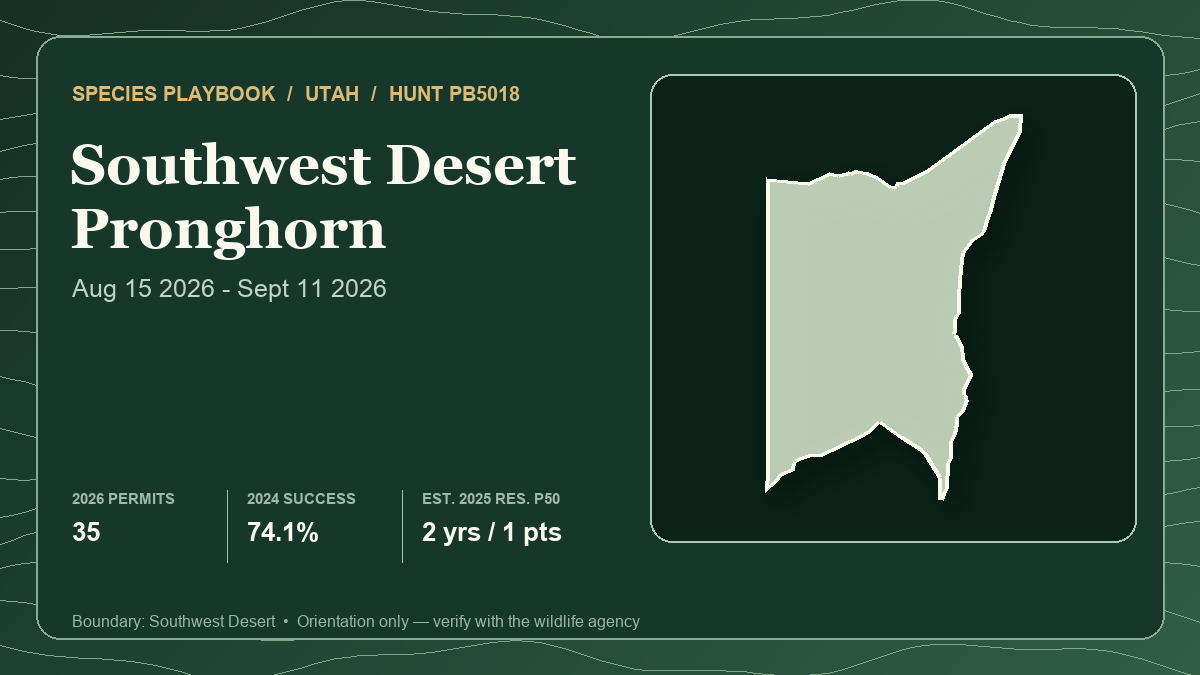
All three archery periods open August 15, 2026. That shared date does not make them interchangeable. Their draw systems, season endpoints, harvest reporting and access problems are materially different. The boundary and stat card above represents lead hunt PB5018 only, not the full three-hunt comparison. Its 2024 harvest statistic comes from the data currently connected to the static Hunt Planner profile; the text below also reports Utah's newer preliminary 2025 result and labels the year.
The pronghorn problem: visible does not mean approachable
Pronghorn are built around open-country detection. Wyoming Game and Fish describes large, side-positioned eyes, a near-360-degree field of view and an ability to detect movement at long distance. The same agency places their core terrain in flat grassland, sagebrush and gentle rolling hills. That combination explains the archery puzzle: hunters can often see the animal long before the terrain offers a safe, hidden approach.
The useful e-scouting unit is therefore not simply “a big basin.” It is a basin paired with small terrain folds, broken rims, shallow drainages and vegetation changes that can hide a careful approach. A route that looks negligible on a broad map may matter more than a prominent glassing knob. Conversely, a road-accessible herd in featureless ground may be observable but effectively unstalkable with a bow.
Food and water need similar nuance. Utah's statewide pronghorn plan says pronghorn strongly prefer forbs and shrubs and reports that grasses make up less than 10% of the annual diet. It also says summer water needs average more than three liters per day and identifies maintained water developments as important in parts of Utah. Wyoming's species profile notes that pronghorn can obtain substantial water from plants and may rarely be seen drinking. Those statements are not a license to assume every dry-country herd uses a predictable tank on a huntable schedule.
Read water as a landscape constraint, not a universal tactic. Current tracks, droppings, legal blind placement, alternate water and recent precipitation all matter. A blind is a poor commitment when several usable sources divide movement. It becomes more credible when repeated observation shows a consistent approach and the setup can be occupied without contaminating it.
Fences also shape movement. Utah's management plan identifies woven wire and low bottom wires as barriers between seasonal range, forage and water. Pronghorn commonly seek a way under a fence rather than clearing it like a deer. For a hunter, a fence is neither a guaranteed crossing nor permission to approach. Treat it as a movement filter, check ownership on both sides and never block or alter it.
Timing: three seasons, three versions of August and September
The August 15 opener catches hot, bright, late-summer conditions in every comparison. Early in that window, bucks may still be associated with summer groups or occupying broad home ranges. Wyoming Game and Fish says breeding usually occurs in September, so a season that reaches deeper into that month can overlap more territorial behavior than a two-week August hunt.
That creates three broad tactical modes:
- Observation and stalk: glass from outside the herd's detection envelope, wait for animals to feed behind a fold, then use that fold rather than trying to cross exposed ground.
- Water or travel ambush: commit only after confirming repeated use, a safe wind and a legal, low-impact blind. Idaho explicitly warns that abandoned blind material is litter and digging a pit on federal land is unlawful.
- Rut-aware mobility: later in the window, watch how bucks relate to doe groups and rivals. A decoy can create an opportunity in some circumstances, but visibility to roads, other hunters and livestock can make it unsafe. Verify current equipment rules before using one.
Wind is the constant. Pronghorn vision gets the attention, but an approach that arrives upwind still fails. Build each plan with a morning wind, an afternoon wind and an exit that does not push animals past another hunter or across a property boundary.
Hunt 1: Utah PB5018 — time and a strong recent archery result
- Current season and weapon: Buck pronghorn, archery, August 15 through September 11, 2026. Utah lists 35 permits: 31 resident and four nonresident.
- Tag path: Limited-entry bonus-point draw. Utah's system retains a random component; a permit appearing at a low point level is not a promise that the same level will draw next year.
- Latest draw evidence: Utah's latest posted limited-entry odds report is 2025. It shows 67 eligible resident applicants for 30 permits, an aggregate ratio of one permit per 2.2 applicants. The nonresident pool had 79 eligible applicants for four permits, or one per 19.8. Those are pool-wide historical ratios, not individual forecasts.
- Latest harvest evidence: Utah's preliminary 2025 report lists 35 permits, 31 hunters, 28 harvested bucks and 90.3% success, with 5.0 average days afield. The local structured record still carries the final 2024 report: 31 hunters, 23 bucks and 74.1% success over 5.5 average days. The data years differ because the preliminary 2025 report appeared after the connected dataset was generated.
- Public-land and access pattern: The boundary spans a mixed-ownership desert landscape. The unit line does not establish a public route, and a public parcel does not guarantee that the practical approach avoids private land. Check the Utah Hunt Planner ownership layer, current land-manager travel rules and any fire restrictions immediately before the trip.
- Terrain character: Broad desert basins, shrub-steppe and broken uplands reward long observation and careful use of minor relief. Water distribution can matter, but the unit is too large and varied for a single water-hole prescription.
- Principal tradeoff: The long season reaches toward September behavior and the recent archery harvest result is strong, but the nonresident draw was exceptionally restrictive in 2025.
- Best for: A hunter who wants time to switch between observation, ambush and rut-aware tactics after earning a limited-entry tag.
Open PB5018 in the Hunt Planner 3D map.
Hunt 2: Idaho 4033 — the compact controlled-hunt test
- Current season and weapon: Either-sex pronghorn, archery only, August 15–30, 2026, with 40 tags.
- Tag path: Idaho random controlled hunt; the state does not use preference points. IDFG says pronghorn hunting, including archery, is controlled-hunt only.
- Latest draw evidence: IDFG's live 2026 table shows 87 resident first-choice applicants for 36 awards, displayed as 41%, and 16 nonresident first-choice applicants for four awards, displayed as 25%. The local profile preserves the 2025 row—37% resident and 13% nonresident—so the year label matters.
- Latest harvest evidence: IDFG reports 36 hunters, 19 pronghorn and 53% success in 2025. The table lists 163 hunter-days, or about 4.5 days per hunter. Unlike Utah PB5018, this tag is either sex.
- Public-land and access pattern: IDFG's current surface-management summary covers 1,920,803 acres and lists 69.9% BLM, 19% private, 6% U.S. military and 4.3% State of Idaho management. One Access Yes! property is listed. These figures describe management, not legal access; military land, private inholdings, road closures and wilderness rules each require separate verification.
- Terrain character: Huge high-desert units combine sagebrush flats with broken canyon country. That scale rewards narrowing the plan to connected feed, relief and verified access instead of trying to “cover the unit.”
- Principal tradeoff: The 2026 first-choice odds were materially more approachable than the Utah nonresident result, but the 16-day season provides less time for weather, reconnaissance and a change of method.
- Best for: A mobile hunter comfortable with a random draw, an either-sex tag and a short, focused August hunt.
Open Idaho 4033 in the Hunt Planner 3D map.
Hunt 3: Wyoming 061-1 — archery access to a full-season license
- Current season and weapon: The 2026 Type 1 license is valid for any antelope. The special archery season runs August 15 through September 18; the regular season follows September 19 through October 31. Wyoming requires both the limited-quota antelope license and a separate archery license during the special archery period.
- Tag path: Wyoming residents enter a random limited-quota draw. Nonresidents choose regular or special pools, with preference and random components. That structure should be read pool by pool, not as one universal odds number.
- Latest draw evidence: The 2026 resident demand report shows a quota of 89 against 594 first-choice applicants, about 15.0% before considering the mechanics behind the published quota. In the 2026 nonresident regular preference pool, 17 points drew three of seven applicants, or 42.86%, while the report shows no licenses below 17 points in that pool. That point-tier result is not the nonresident random-draw probability.
- Latest harvest evidence: Wyoming's 2025 report lists 108 active Type 1 license holders, 96 harvested antelope, 88.9% success and 3.8 days per harvest. Crucially, this is a full-season, all-method Type 1 result, not an archery-only success rate. It cannot be ranked directly against the Utah and Idaho archery-hunt percentages.
- Public-land and access pattern: The local WGFD-derived surface summary lists 75% public land for Hunt Area 61. That is promising planning context, not a guarantee of a drivable or legally reachable parcel. Parcel continuity, road status, seasonal restrictions and retrieval routes still decide whether a block is usable.
- Terrain character: The Chain Lakes country is open sagebrush and rolling basin terrain where small folds matter. The long special archery window makes it practical to scout one pattern in August and adjust as September behavior develops.
- Principal tradeoff: This is the longest archery window and the license continues into the regular season, but current draw demand is substantial and the attractive 2025 harvest percentage includes firearm hunting.
- Best for: A hunter who values a long tactical window and wants the fallback of the regular season, while accepting a competitive draw and a metric that does not isolate bowhunting.
Open Wyoming pronghorn 061-1 directly in the Hunt Planner 3D map.
A field plan that travels across all three hunts
Begin with three map layers: legal surface access, terrain relief and water. Do not mark an animal location until those three layers support a practical approach. Then build plans at three scales.
First, identify several large observation zones rather than one famous basin. Each zone needs a legal arrival, a glassing position outside the skyline and at least one terrain-hidden route. Second, identify decision points: the fold where a stalk becomes possible, the water source that would justify a blind only after current use is confirmed, and the road or fence where ownership must be rechecked. Third, prepare an exit. A failed stalk should not educate every pronghorn in the basin.
For the first two hours of light, favor observation over hurried distance-closing. Note direction of travel, feeding pauses and what causes a buck to become alert. At midday, confirm the wind and inspect only places that can be reached without crossing likely bedding or loafing terrain. In the evening, resist following animals into fading light unless the recovery, ownership and vehicle plan are already solved.
Heat changes the logistics. Carry enough water for the hunter, plan rapid meat cooling and avoid a stalk whose likely recovery would extend deep into the warmest part of the day. The open landscape can make distance and retrieval effort look smaller than they are.
Best fit by hunter profile
- For the hunter prioritizing the longest archery learning window: Wyoming 061-1 offers August 15 through September 18 and a later regular-season option. Do not interpret its 88.9% 2025 full-season result as bow success.
- For the hunter prioritizing a short, relatively attainable controlled-hunt experiment: Idaho 4033 had 41% resident and 25% nonresident first-choice results in 2026, but only 16 season days.
- For the hunter prioritizing a dedicated buck-archery tag and strong recent archery evidence: Utah PB5018 reported 90.3% preliminary success in 2025. Its 2025 nonresident pool was much more restrictive than the other examples.
- For the hunter who needs simple public-land logistics: None is automatic. Idaho publishes a large BLM share, Wyoming's local summary shows a large public share, and Utah supplies an ownership layer, but every plan still needs parcel, road and restriction verification.
There is no universal winner because the metrics answer different questions. Idaho's and Utah's harvest rows isolate archery hunts; Wyoming's row covers a license valid into the firearm season. Utah uses bonus points with random opportunity, Idaho uses a random controlled draw without points, and Wyoming divides resident and nonresident pathways differently.
Verification checklist before applying or hunting
- Reopen the official 2026 hunt listing and confirm season, weapon, sex, quota and boundary.
- Confirm the exact tag and any archery permit or license required; do not rely on a prior-year rule.
- Recheck parcel ownership, legal public access, road status, military or wilderness restrictions and fire closures.
- Verify blind and decoy rules with the wildlife agency and land manager. Remove every part of a temporary blind.
- Separate draw years and pools before comparing odds; a point-tier result is not an overall probability.
- Separate archery-only harvest from mixed-method harvest before using success as a planning signal.
- Use the Hunt Planner maps for orientation, then carry the agency boundary and a field-ready ownership source.
The Hunt Planner methodology explains how structured state records and draw measures are handled. Report a source mismatch or request a correction through the corrections page. Regulations, quotas, access programs, road conditions and preliminary harvest data can change; verify every official source again close to the application and hunt dates.
Sources and verification
- Utah DWR Hunt Planner: PB5018 boundary, 2026 dates and 31/4 permit split
- Utah DWR April 2026 RAC packet: 2026 buck-pronghorn permit tables
- Utah DWR preliminary 2025 big-game harvest report
- Utah DWR 2025 limited-entry drawing odds
- Utah DWR explanation of hunting permit drawings
- Utah statewide pronghorn management plan: habitat, forage, water and fences
- IDFG Hunt Planner: Hunt 4033 dates, 2026 draw, 2025 harvest, surface management and Access Yes!
- IDFG 2026 Big Game Seasons and Rules
- IDFG pronghorn hunting information: controlled-hunt and blind guidance
- Wyoming Game and Fish 2026 antelope seasons and special-archery rules
- Wyoming Game and Fish 2026 resident antelope demand report
- Wyoming Game and Fish 2026 nonresident regular preference-point report
- Wyoming Game and Fish 2025 antelope harvest report
- Wyoming Game and Fish pronghorn species profile: vision, habitat, diet and breeding timing
Official dates, quotas, weapon rules, draw systems and access can change. The 2025 Utah harvest report is preliminary, and the local lead-hunt card still displays the connected final 2024 harvest statistic. Idaho and Utah percentages describe archery-only hunts; Wyoming's percentage covers the full Type 1 license period. These differences are explicit because they prevent a false ranking.