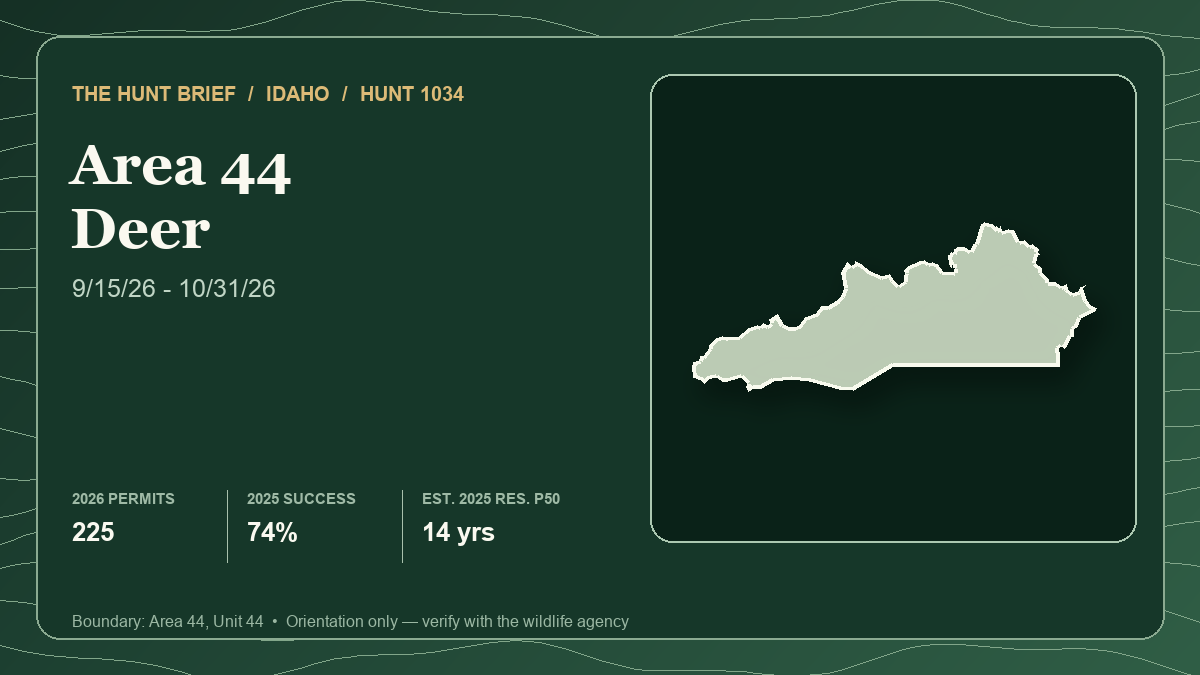
Idaho deer Hunt 1034 has an unusually clean planning story: substantial demand, a stable recent harvest record and a long 2026 season that covers all of Area 44. It is also timely. Idaho Fish and Game reminded successful 2026 controlled-hunt applicants on July 23, 2026, that they must buy their tags by August 1, 2026. Unclaimed tags, except those for unlimited and January hunts, move to Idaho's second drawing.
That announcement does not mean Hunt 1034 will be available in the second drawing. It means a successful 2026 applicant must claim the tag on time, while an unsuccessful applicant should watch the official second-draw list rather than assume this high-demand hunt will appear.
Start with the static Hunt Planner profile for Hunt 1034 and open Area 44 in the Hunt Planner 3D map for terrain orientation.
The quick verdict
Hunt 1034 is a credible long-term application target for a hunter who values a long any-weapon season and is prepared to solve a mixed-access landscape. The 2026 permit total is 225, and the season runs September 15 through October 31, 2026. Idaho's 2026 drawing data show that demand remained much larger than supply for both residency pools.
The tradeoff is straightforward: this is a random controlled hunt, not a preference-point ladder. An unsuccessful year does not move an applicant into a higher point tier for the next drawing. The 2026 odds describe one drawing with one applicant pool; they are not a queue position or a promise about 2027.
What the 2026 drawing says
IDFG's live Hunt Planner page reports 4,243 resident first-choice applicants and 203 resident awards for Hunt 1034 in 2026, shown as 5% odds after rounding. The same 2026 row reports 1,081 nonresident first-choice applicants and 22 nonresident awards, shown as 2% odds. Together, the 2026 awards equal the full 225-tag quota.
For comparison, the local Hunt Planner record preserves the 2025 drawing: 4,206 resident first-choice applicants competed for 203 resident awards, while 981 nonresident first-choice applicants competed for 22 nonresident awards. The displayed odds were also 5% for residents and 2% for nonresidents in 2025. Demand therefore increased by 37 resident first-choice applicants and 100 nonresident first-choice applicants from 2025 to 2026, while the respective award counts stayed at 203 and 22.
A probability scenario helps put the rounded percentages in context. If a hunter somehow faced an independent 5% chance every year, the cumulative chance would cross 50% after about 14 applications. At a constant independent 2% chance, it would take about 35 applications. Those are mathematical illustrations based on the rounded 2026 odds, not expected wait times. Applicant totals, quotas, eligibility and individual choices can change every year.
What the 2025 harvest report adds
The latest completed harvest year on IDFG's Hunt 1034 page is 2025. IDFG reports 205 hunters, 151 harvested deer and 74% success for 2025. The agency table lists 1,534 hunter-days for 2025; Hunt Planner divides that total by the 205 hunters and displays an average of 7.5 days afield.
That result was not a one-year spike. IDFG reports 72% success for Hunt 1034 in 2024 and 74% in 2023. Harvest success is still not a forecast for an individual hunter: weather, access, effort, animal distribution and reporting all shape each year's result. The useful conclusion is narrower—the 2023, 2024 and 2025 reports all show a relatively high proportion of reporting hunters taking a deer.
One table label deserves care. IDFG reports that 74% of the 2025 antlered harvest had four or more antler points. That is an antler-class statistic, not a preference-point statistic; Idaho does not use preference points for this controlled-hunt draw. The 2025 row also reports 3% whitetail, so the reported harvest was overwhelmingly mule deer, but the 2026 tag is valid for an antlered mule deer or white-tailed deer under the current hunt listing.
The access question is as important as the draw
IDFG describes the 2026 hunt area as all of Unit 44 and reports a total area of 353,397 acres. The agency's current surface-management summary lists 48.7% private land, 36.4% U.S. Forest Service land, 9.5% Bureau of Land Management land, 4.7% State of Idaho land and 0.6% Bureau of Reclamation land. Those management percentages are planning context, not permission.
Nearly half-private ownership changes how to read the boundary. A broad public-land polygon can still be awkward to reach if the practical approach crosses private property. Conversely, a public road shown on a basemap does not by itself prove that every spur is open to motorized travel. Confirm parcel ownership, legal public access and current travel rules with the managing agency before committing to an approach.
IDFG's Hunt 1034 page lists no special hunt restriction for 2026 and says there are currently no Access Yes! properties in the hunt area. Neither statement grants access across private land. Treat them as reasons to complete the access check early, not as shortcuts around it.
A terrain-level scouting plan
The September 15 through October 31, 2026 season spans a meaningful transition from late-summer patterns into autumn conditions. Build a scouting plan that can change with the calendar:
- For the early portion of the 2026 season, compare open feeding faces with nearby shaded security cover. Favor glassing positions that let you study both without walking through likely bedding terrain.
- For the middle of the 2026 season, identify several elevation bands and connected cover routes. A single preseason sighting is less useful than understanding how deer can move between feed, shade and escape cover.
- For the late portion of the 2026 season, mark weather-safe access alternatives before storms make a preferred road or steep approach impractical.
- Across the full 2026 season, pair every waypoint with land status and an exit plan. The best-looking basin is not a usable plan until legal access and retrieval are solved.
The boundary card on this page is an orientation graphic, not a field-navigation product. Use the 3D map to compare slope, aspect and large terrain transitions, then verify the hunt boundary and travel status with current IDFG and land-manager materials.
What to do before the August deadlines
If you drew Hunt 1034 in the first 2026 drawing, the immediate task is administrative: IDFG says controlled-hunt tags must be purchased by August 1, 2026, and the agency says there are no exceptions for forfeited unclaimed tags. If you are exchanging a 2026 general deer or elk tag for a controlled tag, IDFG lists July 31, 2026, as the exchange deadline.
If you did not draw, Idaho's second controlled-hunt application period runs August 5–15, 2026. IDFG says successful second-draw applicants will be notified by August 25, 2026, and leftover tags from that drawing go on sale at 10 a.m. Mountain Time on August 25, 2026, or the next business day. Apply only from the official list of tags actually offered. Hunt 1034's 2026 first-draw demand makes it a poor candidate for assumptions.
For a future first-choice application, Hunt 1034 makes sense when Area 44 itself fits the hunter's access, schedule and scouting capacity. The 2025 harvest record is appealing, but the 2026 draw remains the gate: roughly one resident award per 21 first-choice applicants and one nonresident award per 49 first-choice applicants when calculated from the unrounded 2026 counts.
Sources and verification
- IDFG Hunt Planner: Hunt 1034 dates, quota, 2026 draw results, harvest and land-management summary
- IDFG July 23, 2026 notice: August 1 controlled-hunt tag purchase deadline
- IDFG 2026 Big Game Seasons and Rules
- IDFG controlled-hunt application periods and second-draw guidance
- IDFG controlled-hunt drawing odds database
- IDFG harvest statistics database
Official dates, rules, access and tag availability can change. Verify the current IDFG rules, Hunt Planner page and licensing account before buying a tag or hunting. This article used only official agency material; no hunter report is presented as evidence. It was prepared with AI-assisted research and drafting, then checked against the linked sources. Read Hunt Planner's methodology, editorial and AI policy and corrections process.