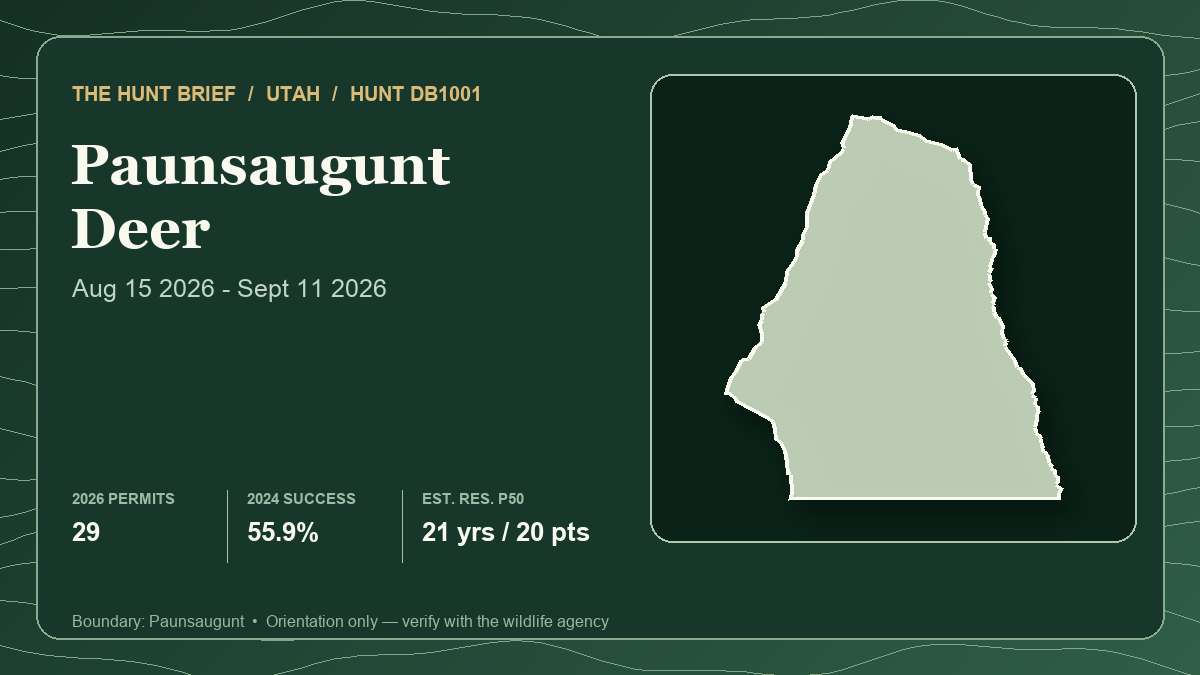
Utah's Paunsaugunt premium limited-entry archery deer hunt is a scarce, high-commitment tag. The 2026 season runs from August 15 through September 11 with 29 permits: 26 for residents and three for nonresidents. Those numbers make the central planning question less about whether the hunt is desirable and more about whether its wait and early-season demands fit the hunter.
The quick verdict
DB1001 is best suited to an archery hunter willing to scout summer patterns, cover large country with optics and adapt when a buck changes elevation or disappears from a familiar basin. The historical harvest result is strong for an archery hunt, but it does not make the tag easy. Hunters should plan for repeated glassing sessions, heat, water constraints and the possibility that a buck located before opening day will change its pattern.
The hunt is a harder recommendation for someone primarily seeking frequent opportunity. In the 2025 draw data, 760 resident applicants competed for 25 permits and 910 nonresident applicants competed for three. Utah's bonus-point system still preserves a random component, so a permit issued at a low point level does not mean that level reliably draws the hunt.
What the official numbers say
Utah lists the 2026 Paunsaugunt archery season as August 15 through September 11. The Wildlife Board kept the premium archery quota at 29 permits, unchanged from 2025. That quota is separate from the Paunsaugunt muzzleloader, any-legal-weapon, management and multi-season hunts, which place other hunters on related country at different times.
The most recent harvest report currently connected to Hunt Planner is for 2024. All 36 permit holders reported going afield, 20 harvested a buck and the reported success rate was 55.9%. Successful or not, hunters averaged 9.6 days afield. The average satisfaction score was 4 on Utah's survey scale.
The 2025 draw report shows an overall resident ratio of one permit for every 30.4 eligible applicants. The nonresident ratio was one for every 303.3. Those aggregate ratios describe that year's applicant pool; they are not a prediction for a particular bonus-point level or a guarantee about a future draw.
What hunters report
Public discussions are consistent about one broad early-season pattern: archery hunters are often looking at higher summer range before later weather and migration redistribute deer. One long-running Paunsaugunt discussion describes bucks found during summer scouting leaving their previous pattern during the archery season. Another discussion characterizes archery deer as higher and farther from private-land concentrations than deer encountered later.
Those reports are useful context, not a unit-wide rule. They are old, anecdotal and do not establish where deer will be in August 2026. Their practical value is the warning they share: do not build the entire hunt around one preseason sighting.
A more recent hunter planning discussion frames the tactical choice as water versus travel routes connecting bedding cover and burns. That is the right kind of question to carry into e-scouting, but the answer should come from current sign, weather and pressure rather than a generic prescription.
Where to begin e-scouting
Start with repeatable terrain patterns instead of named locations:
- Identify high-elevation openings that can be glassed from more than one angle without walking through likely feeding or bedding cover.
- Trace shaded escape cover immediately adjacent to those openings. A visible feeding slope is much more useful when the nearby security cover is also understood.
- Mark water, but also mark the travel routes that let deer approach it with cover and a favorable wind.
- Look for burn edges and mixed-age vegetation rather than treating every burned acre as equally valuable.
- Build at least three plans. Each should have a glassing position, a wind-safe approach and an exit that does not contaminate the next area.
The Hunt Planner boundary image on this page is an orientation graphic, not a navigation map. Open the interactive 3D map to inspect elevation, slope, satellite imagery and land-management context, then verify access and boundaries against the current Utah DWR materials before entering the field.
Who should apply
Apply if the Paunsaugunt itself is the goal, you value a long early archery season and you are prepared to invest scouting time after drawing. The combination of limited permits and a 55.9% reported 2024 harvest rate is compelling, but the 9.6 average days afield is a reminder that the opportunity rewards time.
If the goal is simply to bowhunt mule deer regularly, compare DB1001 with hunts that offer a shorter expected wait. A famous unit can be the right long-term target without being the only useful application choice.
Sources and verification
- Utah DWR Hunt Planner: DB1001 boundary, 2026 dates and permit split
- Utah Wildlife Board 2026 buck deer permit tables
- Utah DWR 2024 limited-entry harvest report
- Utah DWR 2025 big-game drawing odds
- Rokslide: Paunsaugunt discussion
- Rokslide: Paunsaugunt archery discussion
- Hunt Talk: Utah Paunsaugunt archery deer
Official dates, quotas, rules and access can change. Verify the current Utah guidebook and DWR hunt boundary before applying or hunting. Hunter reports are linked as field context and are not treated as official or universally representative.